What Chicago’s 2025 Remodeling Data Reveals About the Real Value of Home Improvements
Before renovating your home, ask yourself: Who are you doing it for?
A minor kitchen renovation in Chicago is estimated to recover approximately 94% of its cost at resale, according to a 2025 Cost vs. Value Report.
While a major kitchen renovation? Just 44% of its cost at resale.
It boils down to a key question: Who are you doing it for?
If you’re planning to spend the next 15 years in that $84,000 kitchen, its value extends far beyond what a future buyer might pay for it. You’re investing in your daily experience, your comfort, and a space tailored around your preferences.
But if you’re planning to sell within the next three years, spending $84,000 on an elaborate kitchen overhaul might not be the wisest financial investment.
The distinction is what you’re hoping to get out of it.
Major vs. Minor Kitchen Renovations
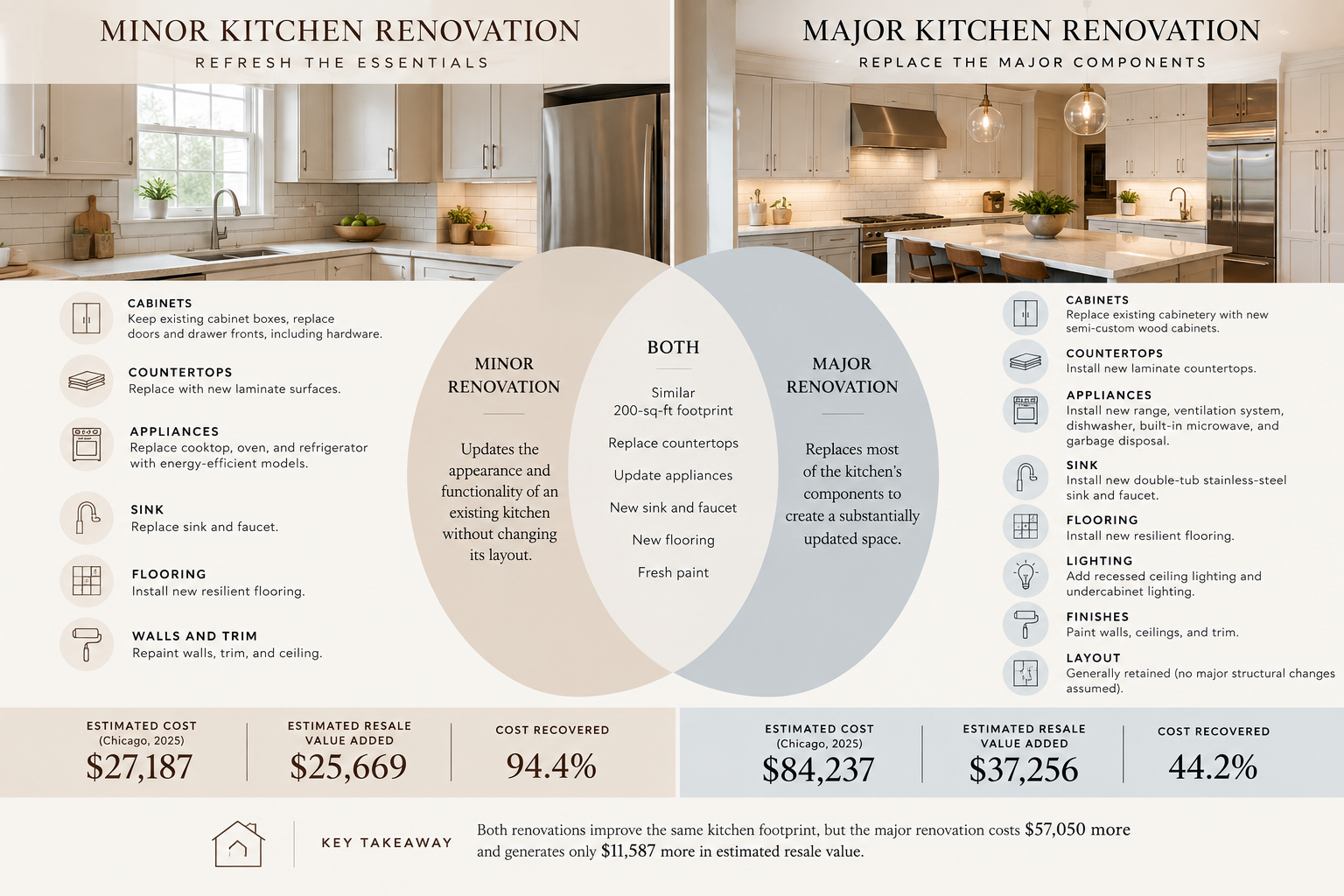
Before examining the numbers, it’s important to understand what actually separates a minor kitchen renovation from a major one.
According to the 2025 Cost vs. Value Report, both projects assume an approximately 200-square-foot kitchen, but the scope of improvements differs considerably.
Minor Kitchen Renovation
A minor renovation focuses on refreshing an existing, functional kitchen without substantially changing its layout or replacing everything inside it.
- Retaining existing cabinet boxes while replacing doors, drawer fronts, and hardware.
- Updating countertops.
- Replacing selected appliances with energy-efficient models.
- Installing a new sink and faucet.
- Updating flooring.
- Repainting walls, ceilings, and trim.
The goal is to modernize the kitchen’s appearance and functionality while preserving much of its existing infrastructure.
Major Kitchen Renovation
A major renovation takes a more comprehensive approach, replacing most of the kitchen’s major components.
- Replacing existing cabinets with new semi-custom cabinetry.
- Installing new countertops.
- Replacing the primary kitchen appliances.
- Installing a new sink, faucet, and garbage disposal.
- Adding recessed and undercabinet lighting.
- Replacing flooring.
- Updating finishes throughout.
Importantly, a major renovation doesn’t necessarily involve expanding the kitchen or removing walls.
Both projects can improve the same space. The difference is how extensively that space is rebuilt.
More Money Spent. Less Value Recovered.
According to the 2025 Chicago Cost vs. Value Report, the financial differences between these two renovation approaches are substantial.
| Minor Kitchen Renovation | Major Kitchen Renovation | |
|---|---|---|
| Estimated cost | $27,187 | $84,237 |
| Estimated resale value added | $25,669 | $37,256 |
| Cost recovered | 94.4% | 44.2% |
| Estimated unrecovered cost | $1,518 | $46,981 |
Source: 2025 Cost vs. Value Report, Chicago. Figures represent modeled estimates for standardized midrange remodeling projects, not guaranteed results for individual homes.
The major renovation costs $57,050 more but generates only $11,587 more in estimated resale value.
That’s approximately 20 cents of additional resale value for every extra dollar spent when comparing the two projects.
The lesson isn’t that major renovations are bad investments.
It’s that the financial return depends heavily on why you’re making the improvements.
Renovating for Yourself vs. Renovating to Sell
When you’re renovating for yourself
Not every home improvement needs to justify itself through resale value.
If you love cooking, an extensively renovated kitchen might fundamentally change how you experience your home.
Perhaps you’re creating a larger island where your family gathers, incorporating appliances you’ve always wanted, or finally designing a layout that works for how you live.
Those improvements have value that a resale report cannot fully capture.
And if you’re planning to enjoy them for the next 10 or 15 years, the financial return at resale may be only one consideration.
Sometimes the return on investment is simply getting to enjoy what you’ve invested in.
When you’re renovating to sell
The equation changes when you’re preparing a property for someone else.
Your personal preferences matter less than what prospective buyers are willing to pay.
An expensive renovation might make your home more attractive, but that doesn’t necessarily mean it will increase the sale price enough to justify the expense.
Before recommending substantial improvements, I want to understand what comparable properties are selling for, which features buyers prioritize, and how much additional value the proposed renovation could realistically create.
Sometimes a comprehensive renovation is warranted.
Other times, a few targeted updates can accomplish much of the same objective at a fraction of the cost.
When you’re renovating to sell, the goal isn’t necessarily to create a better home. It’s to create a better financial outcome.
What if you’re planning to sell in three to five years?
This is where the decision becomes more nuanced.
You’re not renovating exclusively for yourself, but you’re not renovating exclusively for the next buyer, either.
You have several years to enjoy the improvements, while resale value remains a relatively near-term consideration.
In this situation, I would prioritize improvements that meaningfully enhance everyday living without becoming overly personalized or disproportionately expensive relative to competing homes.
There’s no universal formula.
The right balance depends on the property, the neighborhood, your financial circumstances, and how long you realistically expect to stay.
The Takeaway
Chicago’s remodeling data tells a compelling story that spending more on a renovation doesn’t necessarily mean recovering more of that investment when you sell.
Before deciding how much to spend improving your home, decide who you’re improving it for.
Resale value isn’t the only way to measure whether an improvement was worthwhile. A renovation can be a wonderful lifestyle investment without being a particularly strong financial investment. And that’s perfectly reasonable, provided you understand the distinction.
The smartest renovation isn’t always the cheapest or the most elaborate.
It’s the one that accomplishes what you actually want.
See what others miss. Make every move count.
Frequently Asked Questions
What’s the difference between a minor and major kitchen renovation?
A minor renovation generally refreshes an existing kitchen while retaining cabinet boxes and the existing layout. A major renovation replaces most major components, including cabinetry, appliances, countertops, and lighting.
Is a major kitchen renovation a bad investment?
Not necessarily. A major renovation may provide years of enjoyment, improve functionality, and increase resale value. However, homeowners should distinguish between lifestyle benefits and the amount they expect to recover when selling.
Should I renovate my kitchen if I’m selling within three years?
It depends on the kitchen’s condition, the cost of improvements, and comparable sales. A targeted refresh may make more financial sense than a complete overhaul, particularly if the existing kitchen is functional.
Do renovated homes sell for more in Chicago?
Renovated homes can command premiums, but those premiums vary by location, property type, renovation quality, and buyer demand. The cost of improvements does not automatically translate into an equivalent increase in market value.
How do I determine which improvements are worth making before selling?
Compare the property’s likely value in its current condition with its estimated value after improvements. Factor in renovation expenses, carrying costs, timing, and the seller’s expected net proceeds.

